
A multi-cavity mold only runs clean when every cavity releases its cap the same way. Twelve cavities fill. The mold opens. Eleven caps drop clean. One drags on its core.
By shift’s end, the scrap bin holds dented walls, broken threads, snapped tamper bands. People blame the expensive mold. The real problem is often smaller: the bottle cap mold ejection system.
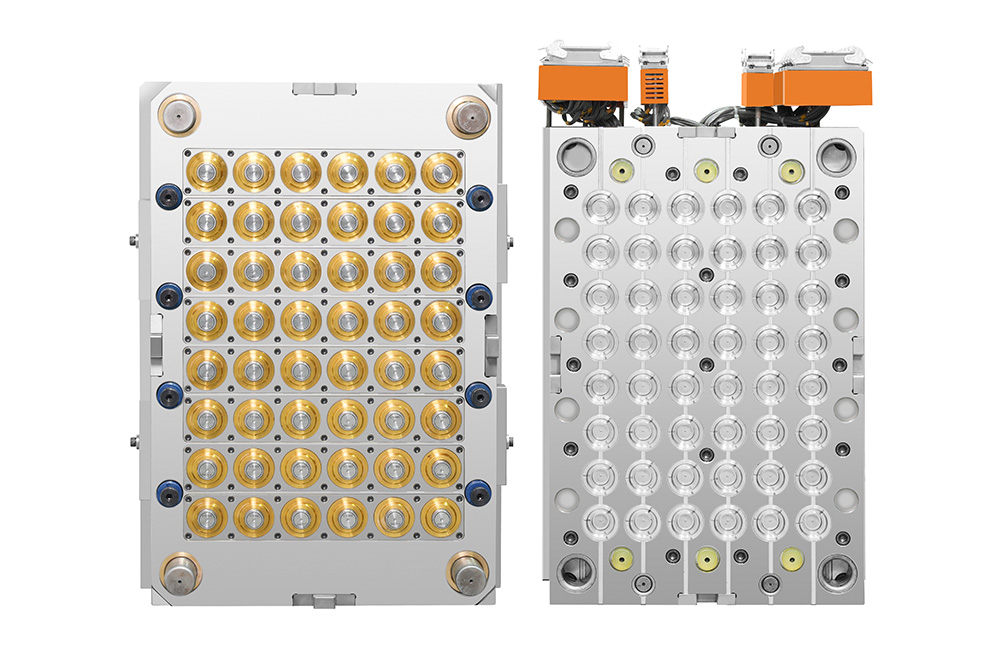
Quick Answer: Which Cap Mold Ejection System to Choose
- Four mechanisms cover most bottle cap molds: stripper plate or ring (short threads, high volume), an unscrewing core (deep threads), ejector pin or sleeve (low cost, leaves marks), and collapsible core or air assist (internal undercuts).
- Choose from the closure drawing outwards: thread depth and profile, the tamper band, wall thickness and undercuts decide which mechanisms can release the cap without damage.
- Ejection speed and stroke sit inside the cycle time and must fit the machine’s ejector plate, stroke and force; validate on a real mold trial before committing the tool.
What Is a Bottle Cap Mold Ejection System?
Every cycle ends the same way: the cap has to come off the core. The machine provides the push; the mold decides where it lands. Get it wrong on a cap mold and the part comes off marked.
Pull while the wall is still soft and it creeps. Wait past the shrink and the cap clamps down on the core. Either way the bad part reaches the inspection sample; on a high-cavity tool, one weak cavity fills the bin.
Common Types of Bottle Cap Mold Ejection Systems
1. Stripper Plate and Stripper Ring Ejection
The cap comes off without being pulled straight. A stripper ring or plate slides over the wall as the mold opens, peeling the cap free around the full perimeter; it keeps its round shape.
The problem is the thread: a deep or stiff thread stretches under a straight pull, and a tamper band below the grip can snap. Ask whether the cap’s geometry and wall thickness allow stripping.
2. Unscrewing Ejection Mechanism
Some caps will not pull off. The mold unscrews them instead.
A rotating core spins the closure out, driven by rack-and-pinion gearing or a small motor. A deep internal thread lets go without a stretch mark, where stripping would scar it.
The cost is maintenance — bearings, gears, seals wear every cycle — so ask a supplier how it replaces the wear parts.
3. Ejector Pin and Ejector Sleeve Systems
Pins are the cheapest way to push a part off a core — and one of the least cap-friendly.
A pin’s footprint shows up in the finished cap — a dimple in a thin wall, stress hiding in the material. A sleeve covers more arc, but one feature still takes the push. Strippers and rotating cores do the real demolding on most caps; pins and sleeves take secondary features.
4. Collapsible Core and Air-Assisted Ejection
These two cover what the first three cannot.
Internal undercuts trap a part on a solid core; a collapsible core retracts in segments to free it — moving parts parked in the mold’s most stressed zone. Compressed air can push a cap off too; on caps it mostly backs up another mechanism.
Find out the service interval — and what a mid-run failure does to output.
| Mechanism | Best for | Watch-outs |
|---|---|---|
| Stripper plate and ring | Short-thread, high-volume closures | Deep or stiff threads stretch, tamper bands can snap |
| Unscrewing core | Deep internal threads | Wear parts: racks, bearings, seals |
| Ejector pin and sleeve | Simple caps, lowest cost | Pin marks and stress in thin walls |
| Collapsible core and air assist | Internal undercuts | Moving parts in the hottest zone; check the service interval |
Key Factors to Consider When Choosing a Bottle Cap Mold Ejection System
Cap Design and Thread Geometry
Thread depth and profile set the pull the cap can take. The tamper band shows what can move without breaking. Wall thickness and undercuts say what a solid core will release.
Plastic Material and Flexibility
Resins don’t shrink uniformly, and spring-back varies too. A stiff high-glass grade fights the stripper; a softer one forgives some stretch, then creeps. Demold a sample of the actual grade and look for permanent set.
Production Volume and Cavity Number
A mechanism that balanced in a four-cavity trial can fall apart at thirty-six. Ask how ejection stays synchronized on a multi-cavity injection mold as parts wear.
Cycle Time and Machine Compatibility
Ejection speed and stroke set a floor under the cycle time; a long stroke eats into cooling. The layout — ejector plate, stroke, force, mounting size — has to fit the machine you will run. Check it before the quote.
Maintenance and Operating Costs
Purchase price leaves out the wear parts. Springs fatigue, gear racks thin, seals harden, and an unscrewing core wears fastest. Work those replacement intervals into the cost model.
How to Select the Right Ejection System for a Multi-Cavity Mold
Step 1. Analyze the Bottle Cap Design
Start from the closure drawing: thread profile, band structure, wall thickness. Mark the features that must survive demolding before picking a mechanism.
Step 2. Define Production Requirements
Target output per hour, first, then the cycle time that gets you there. Ejection takes a slice of that cycle.
Step 3. Evaluate Machine Compatibility
Start with the machine model, then pull its ejector stroke, force, and mounting dimensions. A mechanism asking for more stroke than the machine gives ends the comparison early.
Step 4. Compare Ejection Mechanisms
Line up the candidates against the cap geometry, resin, and production numbers. Cost and maintenance history break the tie.
Step 5. Validate Through Mold Trials
Run the trial on the real cap at the real cycle: demolding stability, cavity consistency, thread dimensions, band integrity. The trial data makes the final choice.
Common Bottle Cap Ejection Problems and How to Prevent Them
The trouble shows up in the product first.
- Cap deformation: uneven or too much force on a thin wall.
- Thread damage: the thread went too deep, or the resin came back too
> stiff, and stripping tore it.
- Incomplete ejection: the stroke ran short, the springs tired, or the
> part would not let go.
- Broken tamper bands: stress hit the band before the cap was free.
- Cavity-to-cavity variation: uneven cooling, or ejection timing that
> drifted.
Check the timing first, then work down through the springs, guides, and bearings. When the causes still will not separate, common defects in injection molded PET caps shows the split between ejection and filling faults.
Why Ejection System Design Matters in Complete Injection Molding Lines
The ejection stage has to agree with the machine’s opening stroke and the take-off robot that times its move to the same signal. Planned apart, they come back as lost cycles, dropped caps, and scratches nobody owns. Planning the tool inside a complete injection molding system support scope keeps them on one sequence.
Choose HEYAN TECHNOLOGY for Customized Bottle Cap Mold Solutions
HEYAN TECHNOLOGY has made precision injection molds for more than 15 years — long enough to know which ejection layouts hold up and which cost scrap. The engineering team works from your cap drawing, resin grade, and machine data — send those with your target output to HEYAN TECHNOLOGY, and the ejection concept is settled before the quote.
No ejection system suits every cap. The right one balances closure structure, material, production rate, and machine — the balance HEYAN TECHNOLOGY builds its bottle cap molds around.
Frequently Asked Questions (FAQs)
What is the most common ejection system used in bottle cap molds?
Stripper ring ejection does most of the work on short-thread, high-volume closures. Where the thread runs deep, an unscrewing core takes over.
How does an ejection system affect bottle cap quality?
Check the wall after a cycle: round, thread crests intact, the band breaking only when it should. Too much force, or force at the wrong time, costs one of the three first.
How can I choose the right ejection system for a multi-cavity bottle cap mold?
Start with the cap geometry and resin. Force and timing have to balance across every cavity and fit the machine’s stroke and your output target.
Which ejection system suits a deep-thread cap?
An unscrewing core. It rotates the cap off the thread instead of pulling it straight, which avoids the stretch marks and tamper-band damage a stripper ring leaves on deep threads; the trade-off is wear on the racks, bearings and seals.
How does cavity number change the ejection choice?
More cavities multiply the force and timing that must stay synchronized. A mechanism that balanced in a four-cavity trial can fall apart at thirty-six cavities, so ask how wear parts are kept in step across every cavity.
